
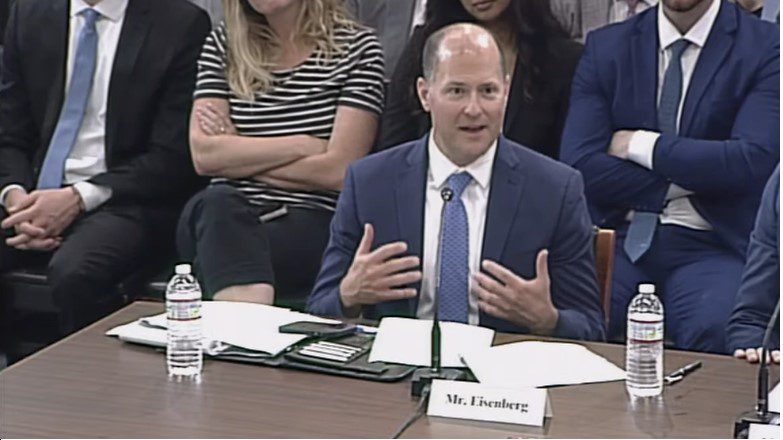
It’s always an honor to testify before Congress.
Part of my job is to interact with lots of elected reps and their staff, but testifying before them in public allows me to advocate on the record for policies that I believe will make our nation a better place.
This time, it also allowed me to bring my 12-year-old son and show him what Dad does at work.
On Wednesday, July 16, I spoke before the House Energy & Commerce Subcommittee on the Environment to advocate for smarter policies to improve plastic recycling and strengthen U.S. manufacturing.
Specifically, how can we do better as a nation at recycling our plastic?
It’s not lost on most Americans that too much plastic goes unrecycled. And too much of that unrecycled plastic winds up in our environment. That’s got to stop.
But how?
America’s Plastic Makers™ have a few ideas. We call it our 3-Point Plan to Recycle More Plastic and Strengthen American Manufacturing.
We believe that recycling more plastic will not only help the environment, it also will strengthen our American economy, particularly our manufacturing sector.
Our U.S. manufacturing sector is deeply reliant on plastic. A new economic analysis by the American Chemistry Council (ACC) reveals that plastic is indispensable to critical U.S. industries – from automotive and aerospace to healthcare and electronics – that employ nearly 5 million Americans and pay over $391 billion in U.S. wages.
Here’s the thing: These critical industries cannot operate without a robust and reliable supply of plastic.
So, that’s what I told the Subcommittee:
“Plastics are indispensable in many applications that make them difficult, if not impossible, to replace with alternatives that deliver the same or better performance, environmental footprint, or cost.
Use of plastics can be the difference between life and death, as items such as IV bags, syringes, gloves, masks and other personal protective equipment and medical equipment are all made with plastic.”
In addition, the plastics manufacturing sector itself employs nearly 670,000 Americans and pays nearly $50 billion in wages. The plastic resin sector has a $22 billion trade surplus – making it one of the limited number of U.S. industries that exports more than it imports.
So, anything we can do as a nation to strengthen our plastic supply chain helps ensure that these critical manufacturing industries can continue delivering essential products… to virtually all Americans.
OK, so plastic is really important to Americans, U.S. manufacturing and our economy.
But how do we recover more of that plastic and recycle it?
“America’s Plastic Makers believe in a future where used plastic does not end up in the environment, but is instead reused, remade into new plastics, or converted into valuable raw materials that society needs.”
“To get there, we must modernize the way we collect, recycle and reuse plastic and other materials. This is not a small task, but we believe we can get there with the right policies.”
This was the crux of my testimony: We need to update outdated public policies that are holding back innovation in recycling.
Today, many Americans and companies are demanding products made with recycled plastic. The good news? Advanced recycling technologies allow U.S. companies to dramatically increase the types and amount of used plastic that can be turned back into new plastic and other products, again and again.
These emerging technologies can expand our nation’s ability to produce essential materials here in America through recycling. The materials are already here – we just need to recover them after use and recycle them.
Advanced recycling technologies can help us:
- Strengthen our nation’s supply chains and improve competitiveness;
- Create thousands of well-paying U.S. jobs; and
- Recover/recycle more plastic and reduce landfill waste.
That’s where our 3-Point Plan comes in. It calls on policymakers to:
- Recognize advanced recycling as manufacturing and count plastic made this way as recycled content.
- Establish national recycling standards to bring consistency and scale to plastic recycling.
- Assert American leadership in negotiations on aglobal agreement to end plastic pollution.
These three steps build on our 5 Actions for Sustainable Change, our comprehensive proposal to accelerate plastic circularity, boost U.S. competitiveness and increase access to American-made recycled plastic. And they’ll further enable critical industries to manufacture and deliver the essential and often life-saving products that all Americans rely on.>
Stronger U.S. supply chains. More American manufacturing. More recycling. Less waste.
The U.S. can lead the world in recycling innovation, grow domestic jobs and reduce plastic waste – all at the same time.
That’s the message I delivered to Congress.
And my message to my 12-year-old esteemed colleague who joined me in the hearing room? It’s always honorable to stand up for what you believe in. Oh, and nice suit.

